 The Crowd
Bingo
One game for the whole room. Buy a card at the slit and daub the numbers as they're called.
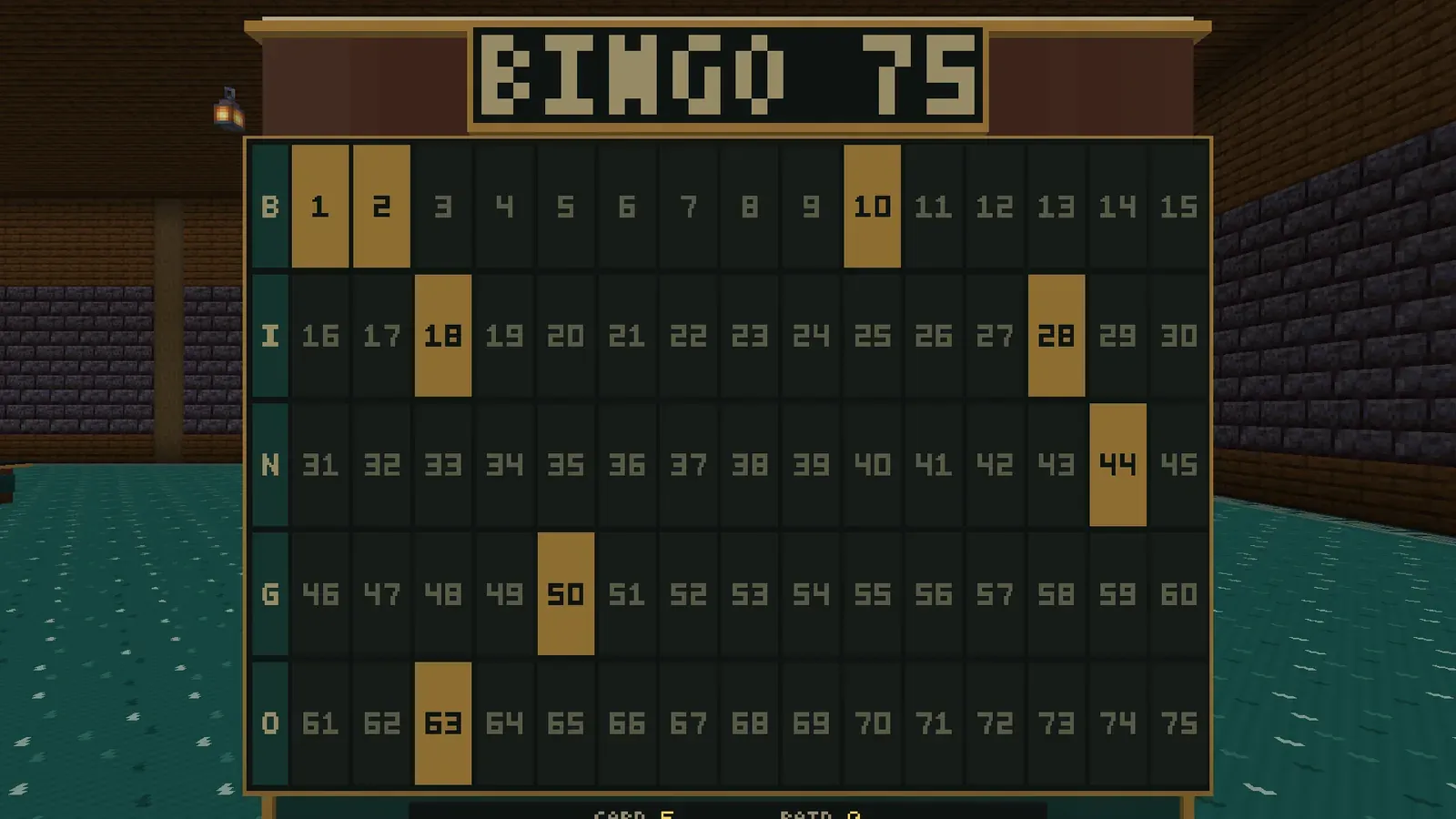
The Bingo Cabinet runs one game of bingo for everyone in the room. Buy a card at the slit, hold it up, and daub the numbers as they’re called. It plays 75-ball or 90-ball, and there’s a multiplier version where one game can pay out more.
Getting one
Section titled “Getting one”Craft it from paper, a Ball Cage, green casino felt and planks. See Recipes. Chips come from the cashier. Cards have no recipe: they’re only sold at the slit.


| The cabinet | |
|---|---|
| Room | 3 blocks across and 3 up, clear. It’s placed at your click and runs to your right and up, facing you. |
| Light | None |
| Hardness | 2.5. An axe is quickest, and anything breaks it. It drops itself. |
| Owner | Whoever places it. One placed by a dispenser or a command has no owner, and anyone with a Pit Boss Key can run it. |
| Turning it | The  Croupier’s Wrench turns one you own a quarter turn, while no card is sold for the coming game. |
How to play
Section titled “How to play”- With
 chips in hand, Right-Click on the chip slit buys one card, and your change comes back. Shift + Right-Click buys as many as your chips cover, up to four a game.
- Each card goes into your inventory.
- Holding Right-Click with a card in hand brings it up and holds it still. Your other hand has to be empty.
- Left-Click daubs the called number under your crosshair.
- Chips in the slit
- The sale runs
- Balls are called
- Daub your numbers
- A pattern pays at the next ball
The slit is small: it’s in the middle of the bottom row, under the CHIPS label. Chips short of a card’s price wait in the slit for the rest, and the price strip shows what you’ve PAID.
The game
Section titled “The game”The first card bought opens the sale, and nobody can cut it short. More players buy until it runs out. Then the balls come out every five seconds by default: the board lights each called number gold, the Last Call window shows it, and the dealer or the caption calls it.
All three prizes are live from the first ball:
| Cards | Prizes |
|---|---|
| 75-ball | A line (any row, column or diagonal, the free centre counting), the four corners and the coverall. |
| 90-ball | One line (a row of the ticket), two lines and the full house. |
When your daub completes a pattern and its prize claim is accepted, the winning cells turn gold. The claim is announced at once and paid at the next ball. A pattern completed too late stays daubed and tells you that another card already claimed the prize. Anyone whose card that same ball completed, and who daubs it before the next ball, shares the prize. The game ends when the coverall or the full house is paid.
Winnings arrive as chips in your inventory while you are within 32 blocks. You do not turn in the card. Winnings held while you are away can be collected from the cabinet with an empty hand.
A small room still gets a proper game, because the house plays cards of its own to fill it. Their count is on the prize placard, and a house win is called out as “the house”. That means you can play bingo on your own.
In multiplier bingo, one multiplier for every prize in the game is drawn and shown for ten seconds before the first ball. Cards cost more.
Where you aim decides what happens.
| You hold | Where | Right-Click | Shift + Right-Click |
|---|---|---|---|
| Chips |
The chip slit | Buys one card | Buys as many as you can, up to four a game |
| Chips |
The rest of the cabinet | As an empty hand there | Swaps small chips for bigger ones |
| Nothing | Anywhere on the cabinet | Collects what the cabinet holds for you, or says where the game stands | The same |
| A card |
Anywhere | Brings the card up | |
 The Pit Boss Key |
Anywhere | Opens the owner’s settings |
- A daub needs the number called, your card’s own game, and you within 32 blocks. A number not yet called is refused and named.
- The prize placard under the slit turns through each prize: what it pays, claimed, who it went to, or kept by the house, then the house’s cards and the multiplier. When the game ends, it holds the final winner for the whole result display.
- Cards go on sale with the first card and stop when the balls start. They stay off until the result has cleared.
- The board shows each ball only as it’s called. The draw never leaves the server.
Good to know
Section titled “Good to know”- As many players as come, each with up to four cards. A latecomer watches this game and plays the next.
- A card is the card. Hand one to a friend and it pays whoever daubs it. A card for a game that’s over is just paper.
- Stand close to be paid. Winnings come as chips when the prize is paid if you’re within 32 blocks. From further away, they wait for your next Right-Click on the cabinet with an empty hand.
Claims and shares
Section titled “Claims and shares”- Shares are per card. A player with two sharing cards gets two shares, and an odd credit left by an even split stays with the house.
- One daub can claim several prizes at once.
- A late daub on a card an earlier ball completed can still claim a prize nobody holds, but can’t join one already claimed.
- House cards daub every ball at once and claim on the ball itself, so a player completing the same prize before the next ball shares with the house.
- The claim is announced to everyone within 32 blocks, and the payment goes to chat. The last prize sets off gold dust and fireworks.
- Unclaimed prizes. If every ball is out and a prize is still unclaimed, players get one more ball’s time to daub. Then the house keeps it. With house cards in play that can’t happen to the last prize.
Timing
Section titled “Timing”- Three timers run a game: the sale, the gap between balls and how long the result holds. A server sets all three.
- The multiplier shows for ten seconds before the first ball, whatever the server’s timers.
- Chips short of a card come back when the balls start, if you’re within 32 blocks.
For owners
Section titled “For owners”- The Pit Boss Key has a Game tab for the cabinet. Cards picks 75-ball or 90-ball, and Game picks ordinary or multiplier bingo. Both are fixed from the first card sold until the game ends.
- The card price and the three prizes on the key count only in a banked house, where the owner’s bank pays them. An infinite house always uses the server’s.
- The overdraft. In a banked house, prizes the bank can’t pay are borrowed against the owner’s overdraft, down to the cabinet’s overdraft floor, which only the owner sets. The overdraft only backs a game no richer than the server’s, one whose prizes are worth no more for its card price than the server’s are for theirs. A richer game needs all its prizes in the bank first. A cabinet that can’t cover a game’s prizes sells no cards, and while a house owes on its overdraft, its owners can’t play their own game.
- Handing it on isn’t possible while a game is on. A new owner starts with the server’s card price and prizes, no overdraft floor and no co-owners. The format and mode stay.
- Withdraw All keeps the prizes’ cover in the bank while a game could still pay them.
- A comparator reads cards sold against the house’s fill, at full strength once the room alone makes the game. Hoppers can’t feed it.
- A hired dealer stands beside the cabinet in Big Six’s costume, calls the sale, “Eyes down” and every ball, and in multiplier bingo turns to reveal the multiplier.
Closing it
Section titled “Closing it”- Closing with the Pit Boss Key during the sale hands every card’s price back, and the cards become paper. During a game, the game finishes. Closing it also sends the dealer away.
- A redstone close waits for a game to finish, then sends everyone’s credits home.
- Maintenance, or the server turning it off, hands the sale back, or plays a game out at once and pays it.
Breaking it
Section titled “Breaking it”| What breaks it | What happens |
|---|---|
 Any player, during the sale |
Every card’s price comes back, and every player’s credits go home. |
| Any player, during a game |
The game is played out on the spot: each card’s prizes go to whoever holds the card, then its last dauber, then its buyer. Then everyone’s credits go home. The bank repays the owner’s overdraft and the rest goes to the owner. |
 A player who isn’t an owner, with protection.sealedTables on |
Refused with “This belongs to somebody else.” |
 An explosion, with protection.sealedTables on |
The cabinet survives if it has an owner. |
For servers
Section titled “For servers”- The server’s
bingosection sets the sale (windowTicks), the time between balls (callTicks), how long the result holds (showTicks), how many cards the house fills each game to (houseFill, where 0 means none), and the default card price and prizes (cardPrice,prizeLine,prizeCorners,prizeCoverall; the prize keys serve the 90-ball prizes too). See Configuration. crowd.overdraftCapis the most one owner may owe across all their tables.bingo_cabinetingames.disabledturns it off. It can’t be placed, takes no card, and hands back or plays out what’s on.- Comp points for a card count as if it cost the server’s own card price, whatever the owner charges.
/highrollers odds bingoshows the card, the prizes, the house’s cards and what a card gets back.- Bingo cabinets aren’t built into found casinos.