 Run the house
The banked house
Tables with a real bank, so losses feed the bank and wins come out of it.
A server picks how its casinos handle money, and it’s one setting. In an infinite house, winnings appear from nowhere and losses vanish. In a banked house, every table has a bank its owner funds, so the house can only pay what it holds. This is the mode for servers with an economy.
The two modes
Section titled “The two modes”| Infinite (default) | Banked | |
|---|---|---|
| Where wins come from | Nowhere. They’re made when needed. | The table’s bank. |
| Where lost stakes go | Nowhere. They vanish. | Into the table’s bank. |
| Who funds it | Nobody. | The table’s owner. |
| Good for | Singleplayer and small friend servers. | Servers where chips are worth something. |
The casinos you find out in the world are the exception: they’re banked on every server, and run on the casino’s own funds until somebody claims one. See Breaking the bank.
The table bank
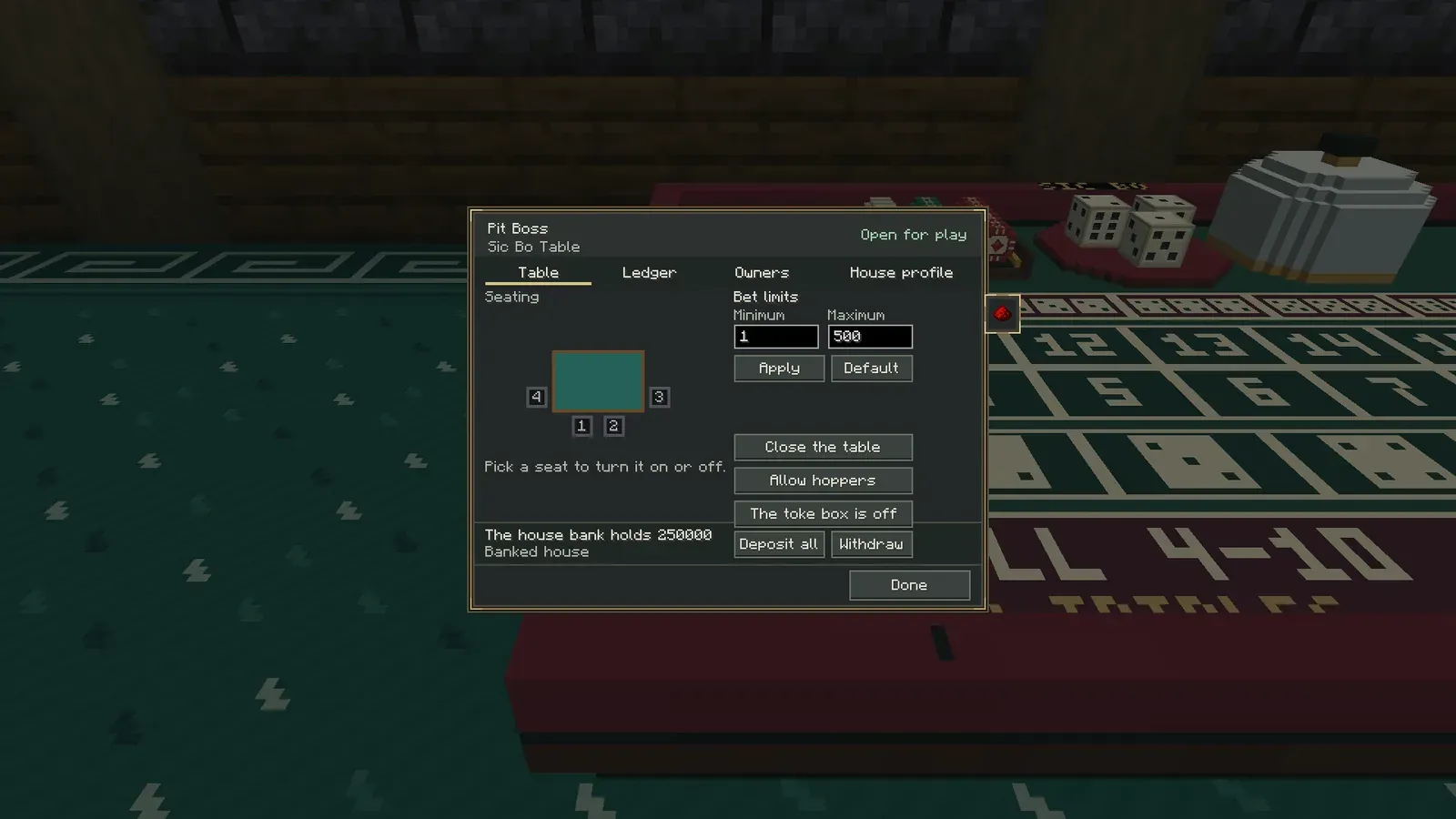
Section titled “The table bank”A banked table holds a bank, a stash of chips inside the block. The owner opens it with the Pit Boss Key on the Table tab.
- Deposit all puts every chip you carry into the bank.
- Withdraw takes out what the bank can spare.
- A bet the bank couldn’t pay at its best result is refused, with a message saying so.
- The owner deposits chips
- Players bet
- Lost stakes go into the bank
- Wins are paid from it
- The owner withdraws what it can spare
- Withdraw keeps cover back. While bets are down, the bank keeps what they could still win, plus every stake that could be taken back. In an infinite house it takes the lot.
- Withdraw waits for a result. While a keno draw, a race or a game show is still playing out, it’s refused until the result has shown.
- Who can touch a bank: the owner, the co-owners and operators. A table nobody owns can be run by anyone with a Pit Boss Key.
- Deposit all takes chips only, from your inventory and off hand. Withdraw pays in the fewest chips, and what won’t fit is held for you until your next login.
- Each game words its refusal its own way. A cashier names its float, bingo names a game’s prizes, an arcade machine names the win it would pay in chips. Texas Hold’em and Liar’s Dice play for the players’ own pots, so they never ask the bank.
Cashiers and stock
Section titled “Cashiers and stock”The Cashier’s bank is its float. Chips a player buys come out of the float, and chips they sell go into it. Its stock of items is real too, so a casino only has as many chips to sell as its cashiers were funded with. The owner’s own rates only count in a banked house: an infinite cashier trades at the server’s. See Chips and the cashier.
Comps and prizes
Section titled “Comps and prizes”In a banked house, the prizes in a prize machine are the owner’s own stock, and comps earn at a rate the server sets. An arcade machine’s prize shelf, in either house, takes plain items only: nothing damaged, enchanted, named or holding anything. A coin pusher, Plinko or pull-tab win of a rarity the owner hasn’t stocked is paid in chips from that machine’s bank.
Other ways money moves
Section titled “Other ways money moves”| In | Out |
|---|---|
| Lost stakes, in a banked house | Wins, in a banked house |
| Deposit all | Withdraw |
| Chips fed by a hopper, when the owner allows it | A progressive jackpot’s slice, in a banked house: real chips leave the bank for the pool |
| Tips in the toke box | Paying off the owner’s overdraft |
| The rake from Texas Hold’em and Liar’s Dice |
- Hoppers, tips and the rake go into the bank in an infinite house too, and Withdraw can take them out.
- A banked jackpot pool starts empty and grows only from the slices. An infinite pool starts from its seed. Found equipment and player equipment can’t share a link, and nor can banked and infinite tables.
Posted prizes and the overdraft
Section titled “Posted prizes and the overdraft”Bingo, the racing cabinet and the game show post prizes before anyone has lost a stake.
- In a banked house a game opens only when its bank, plus what the owner may still borrow, covers every prize. The part the bank can’t pay is borrowed against the owner’s overdraft.
- The overdraft is the owner’s, across all their tables, up to a cap the server sets. A bingo cabinet’s owner can set a lower floor for that cabinet.
- It’s paid back out of a Withdraw, a hand-over, a broken table or an operator setting the bank.
- While an owner owes, they can’t play their own posted-prize game, and a house can’t be handed on.
- A richer game than the server’s, with prizes worth more for their card price, gets no overdraft. Its bank has to hold every prize first.
Owners at their own tables
Section titled “Owners at their own tables”- An owner or co-owner earns no comp points for rounds at their own banked table, and those rounds don’t count toward a tier or their record. The stake is going into their own bank.
- Handing a table on gives the new owner no co-owners, and the table’s own settings go back to the server’s. What the bank can spare pays off the old owner’s overdraft first.
When a table goes
Section titled “When a table goes”| What happens | Players’ credits | The bank |
|---|---|---|
| The table is broken | The round plays out, then credits go home: to your pocket if you’re online, held for your next login if not | The overdraft is paid first, then the rest goes to the owner, or drops as chips if nobody owns it |
| The owner closes it | Stay. The round in play finishes, and players can still cash out. | Stays |
| Redstone closes it | The round finishes, then credits go home | Stays |
| Maintenance | Every round plays out and pays, then credits go home. Open laptop rounds go back to their accounts. | Stays |
| The server turns the game off | The round plays out, then credits go home | Stays |
| Logging out or a restart | Stay on the table | Stays |
Laptops
Section titled “Laptops”A found casino is open to laptops until somebody claims it, and its new owner opens it again. A player-built house is open on an infinite server and closed on a banked one until its owner turns it on. Online play in a banked house draws on the owner’s own online bank, funded on the house screen’s Online tab, and closing a house to laptops sends every open online stake back.
Ledger
Section titled “Ledger”Every table keeps a house ledger in both modes: what was wagered and paid, all time and by day, and the last settlements by name.
For servers
Section titled “For servers”- House mode.
house.modeisINFINITEorBANKED. - Comps.
comps.bankedRatesets how much of a comp point’s value a banked house pays. Zero turns comps off. Found tables use it on an infinite server too. - The overdraft cap.
crowd.overdraftCapis the most one owner may owe across all their tables. - Protection.
protection.sealedTablesstops anyone but an owner breaking an owned table, and explosions spare it. - Maintenance.
/highrollers house maintenance oncloses every table at once and sends every open stake home. The banks stay where they are, and the switch survives a restart. - The ledger.
/highrollers house listshows every table, its owner, its bank and its take. - Operator commands.
/highrollers bank <pos>shows a table’s bank and who owns it, andsetchanges it. An operator can also give a player chips, set a roulette wheel or a cabinet’s card, and reload datapacks, all without a Pit Boss Key. - Permissions.
highrollers.house.manageruns any table,.ownacts as any table’s owner,.commandruns/highrollers house,.operateruns the operator commands,.auditreads the audit log, and.accountreads a player’s ATM balance. Each defaults to operators.