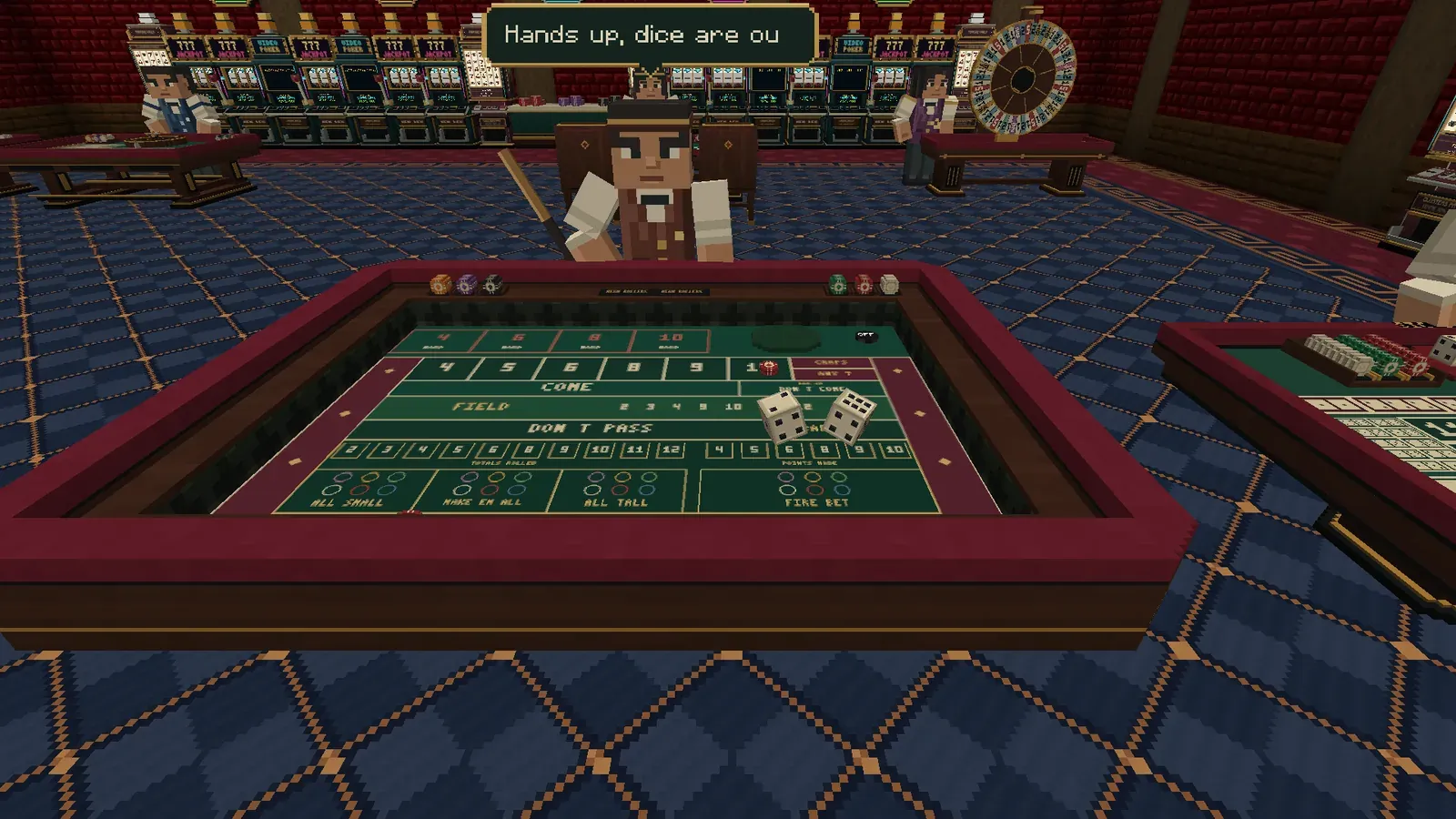
The Craps Table is the loud table. One player shoots, everyone bets on the roll, and up to six players share a round against the house. It looks like a lot of spots, but you can play it with just the pass line.
Getting one
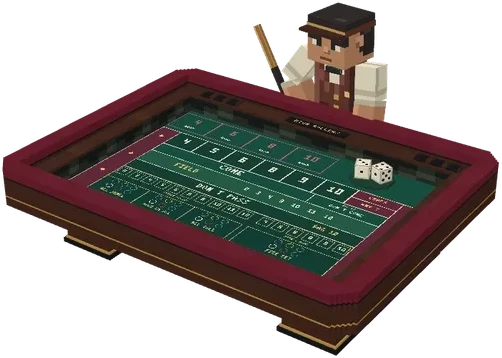
Section titled “Getting one”Craft it from Green Casino Felt, a bone, a stick, planks and a Dice Cup, a part you make first. See Recipes. It needs a flat 4 × 3 space, one block high.


| The table | |
|---|---|
| Room | 4 × 3 × 1 clear. Carpet in the way stays under the table. |
| Light | None |
| Hardness | 2.5. An axe is quickest, and anything breaks it. It drops one table, whichever part you break. |
| Owner | Whoever places it. One placed by a command has no owner, and anyone with a Pit Boss Key can run it. |
| Turning it | The  Croupier’s Wrench turns one you own a quarter turn with a Right-Click, but not while a bet is down. |
| Seats | Six stools: four along the front, one at each end. |
How to play
Section titled “How to play”Betting. With  chips in hand, aim at a spot on the layout.
- Right-Click puts down the fewest chips the spot accepts.
- Shift + Right-Click puts your whole stack on it.
- Right-Click a spot with an empty hand takes all your chips on it back, while betting is open.
The pass line backs the shooter and don’t pass bets against them, both put down on a come-out roll, while no point is set. Once a point is set you can add odds behind your line bet. The other spots bet on the next roll, or on a number coming up before a seven.
The shooter. The first player to bet becomes the shooter, and the table tells them so. The first bet opens a betting window, and later bets don’t stretch it. Then the dice go, when the countdown ends or when the shooter Right-Clicks the plate to throw sooner. The countdown throws even if the shooter has walked away.
The come-out. The first roll with no point set is the come-out. A seven or eleven wins for the pass line, and two, three or twelve loses it. Any other number becomes the point, and the puck turns to ON in its box. From then on, the point rolling again wins for the pass line and a seven loses it, which is a seven out. Either way the puck goes back to OFF and the next roll is a come-out.
Keeping the dice. The shooter keeps the dice while any bet at the table is still standing. When a roll leaves nothing down, the dice are free, and whoever bets next shoots. A seven out always settles every bet, so the dice change hands after one.
The result. It lands in chat with the total and what it means, for bettors within 16 blocks. Winnings come back as chips if you’re near, and wait for your next Right-Click on the table if you’ve wandered off.
- Chips on the layout
- The shooter throws, or the countdown does
- The dice rest and the roll is paid
- The dice come home
- The window opens again while bets stand
Where you aim decides what happens. The outline under your crosshair shows the spot you’d bet on, or the plate.
| You hold | Where | Right-Click | Shift + Right-Click |
|---|---|---|---|
| Chips |
A spot | Bets the fewest chips the spot takes | Bets the whole stack |
| Chips |
The plate | Throws, if you’re the shooter | Swaps small chips for bigger ones |
| Chips |
Anywhere else | Collects anything owed | Swaps small chips for bigger ones |
| An empty hand | A spot, betting open | Takes all your chips on it back | Collects anything owed |
| An empty hand | The plate | Throws, if you’re the shooter | Collects anything owed |
| An empty hand | Anywhere else | Collects anything owed, or says how long betting has left | The same |
 The Pit Boss Key |
Anywhere | The same as an empty hand | Opens the owner’s settings |
- Look at the table with Shift held and its rules card appears at the side of your screen: the bets, how far odds can go and this table’s limits.
- The caption at the top of your screen shows while you aim at a spot or the plate: the bet’s name, the point, the seconds to the throw and who shoots.
- The next throw waits for the dice to come home.
The parts
Section titled “The parts”Turn the table, zoom in, play what it does, and click a part to see what it’s for.
- Dice plate
- The dice rest here between throws. The shooter Right-Clicks it to throw now, or the countdown throws for them.
- Puck
- Black and OFF at its rest while there's no point. A roll that sets the point turns it white and ON in that number's box, and a seven or the point made takes it back.
- Pass line
- The U along your side of the felt. Bet it on a come-out. Once a point is set, chips here go down as odds behind your own pass bet.
- Side bets
- Inside the pass line: All Small, Make Em All, All Tall and the Fire Bet. Each player's chips sit on their own place in the box.
- Bars
- Two rows of numerals. A gold bar rises under a total once it's rolled for All, Tall and Small, and under a point once the shooter makes it for the Fire Bet.
- Don't pass and field
- Don't pass goes down on a come-out, and becomes the odds you lay behind it once there's a point. The field is a bet on the next roll alone.
- Come and don't come
- Like the pass line and don't pass, for when a point is already set. After its first roll a come bet moves to that number's box.
- Place numbers
- 4, 5, 6, 8, 9 and 10: a bet that the number rolls before a seven. Beside them, Any seven and Any craps, each for the next roll alone.
- Hardways
- Hard 4, 6, 8 and 10: the number rolled as a pair before it comes the easy way or a seven does.
- Dealer
- A villager the owner hires with the Pit Boss Key. Throws for show as the dice go, and draws them back with the stick. Without one, the dice slide back on their own.
The bets
Section titled “The bets”| Spot | What it’s on |
|---|---|
| Pass line | The shooter’s roll winning. Goes down on the come-out only. |
| Don’t pass | The opposite, except a twelve on the come-out comes back to you. Goes down on the come-out only. |
| Come and Don’t come | Like the pass and don’t pass lines, put down once a point is set. After its first roll the bet moves to that number’s box. |
| Odds | An extra bet behind your own line bet, paid at true odds. With a point set, the pass line and don’t pass boxes take odds instead. |
| Field | The next roll: 2, 3, 4, 9, 10, 11 or 12 wins, and 2 and 12 pay more. |
| Any seven and Any craps | The next roll alone: a seven, or a 2, 3 or 12. |
| Place 4, 5, 6, 8, 9, 10 | That number rolling before a seven. |
| Hardways (4, 6, 8, 10) | That number rolling as a pair before a seven or the easy way. |
- Place and hardway bets sleep on a come-out and wake once there’s a point. A winning one is paid and comes off the felt.
- Some spots take chips in steps, set by the table’s card. A click puts down the fewest chips that fit, and a bet off the step is refused with what it takes.
- Odds go behind your own line bet, up to a number of times its size set by the card. Come bets take no odds.
- Contract bets stay. A pass or come bet with its point set can’t come back, and nor can a don’t pass once the point is on, because its box is then the odds box. A come bet that has moved can’t be clicked: its number’s box is a place bet.
- There’s no horn bet, and no way to keep place bets or hardways working on a come-out.
Side bets
Section titled “Side bets”Four boxes in a band inside the pass line hold the side bets. Each player’s chips sit on their own place in each box, in their own colour, kept from their first bet until their last. Two rows of bars keep count: ten for the totals rolled since the last seven, and six for the points this shooter has made.
| Box | What it’s on |
|---|---|
| All Small | Every total from 2 to 6 rolling before a seven. |
| All Tall | Every total from 8 to 12 rolling before a seven. |
| Make Em All | All ten of those totals rolling before a seven. |
| Fire Bet | The shooter making four or more different points before they seven out. Five points pay more, and all six pay more again. |
- All Small, All Tall and Make Em All go down while their bars are empty, just after a seven, or when nobody at the table has one down, which starts their bars afresh. Each pays the moment its last total rolls, and any seven ends them, a come-out seven included.
- The Fire Bet goes down only before a new shooter’s first roll. It pays when the shooter sevens out, or the moment the sixth point is made, and a point made twice counts once.
- Any side bet can be taken back until the next roll. After that it rides.
- Their top stakes are the server’s, apart from the table’s own.
Stakes and winnings
Section titled “Stakes and winnings”- The stake leaves your hand as you bet and goes to the table’s bank. Bets stay on the felt across rolls until they win, lose or come back.
- The limits are per spot. The smallest bet applies to every click, and the largest to everything you have on one spot.
- Six players a round. A seventh can’t bet until the next one.
- Each roll is settled as it’s thrown, but nothing can be collected until the dice rest.
- Winnings come as chips to a winner within 16 blocks and online. Otherwise the table holds them until you Right-Click it. A full inventory holds the rest for your next login.
- Leaving doesn’t cost you. Logging out or walking off leaves your bets down, and the countdown keeps throwing.
If the table is broken, the house goes under maintenance or the server turns craps off, every bet you could still take back comes back. Contract bets are rolled out by the server until each is decided, and paid as they fall. Then everything goes home: as chips if you’re online, and held for your next login if you’re not. Redstone closing the table waits for the round to finish first.
A bet is checked in this order
Section titled “A bet is checked in this order”The first check that fails is the message you see:
- The table open
- The dice not out
- A bet this table takes
- Within the limits
- On the spot's step
- A place among six players
- Allowed at this point in the hand
- The bank can cover it, in a banked house
- Enough chips in hand
Timing
Section titled “Timing”- The betting window is a server setting. It opens with the first bet and again each time the dice rest while bets stand, but never before the dice are home.
- A hired dealer throws for show, timed so the dice leave as the hand comes through, then draws them back with the stick. Without one, the dice slide back on their own over the same time.
For owners
Section titled “For owners”- The owner, their co-owners and operators run the table with the Pit Boss Key: the six stools, the bet limits within the server’s, open and close, redstone control, hoppers, the toke box, the dealer, the owners list and, in a banked house, the bank.
- Closing the table refuses new bets, but bets already down keep rolling to their end.
- In a banked house the table’s bank pays every win and must cover the biggest each bet down could ever win, or a new bet is refused with “The house can’t cover that bet right now.” See The banked house.
- A hired dealer throws for show, sweeps the dice home and nods when a roll lights a bar. See Dealers.
Redstone
Section titled “Redstone”A comparator against any block of the table reads how many players have a bet down:
 0358101215
- The Pit Boss Key’s redstone control can open the table always, only with a signal, only without one, or for one round per new signal.
- Hoppers, if the owner turns them on, feed chips into the table’s bank, never into a bet.
Breaking it
Section titled “Breaking it”| What breaks it | What happens |
|---|---|
 Any player, by default |
The table drops. Bets come back or are rolled out, everyone’s winnings go home, and in a banked house the bank goes to the owner, or drops as chips if nobody owns the table. |
 A player who isn’t an owner, with protection.sealedTables on |
Refused with “This belongs to somebody else.” |
 An explosion, with protection.sealedTables on |
The table survives if it has an owner. |
 Anything, in a found casino whose bank isn’t running |
Nothing. It can’t be broken or blown up until the casino is running again. |
For servers
Section titled “For servers”- The payout card is a datapack file,
data/highrollers/craps_payouts/standard.json: what each bet pays, how far odds can go, and the steps each spot takes. Every table plays the card namedstandard, so a datapack changes craps by replacing it. A hand keeps the card it started on. See Odds and datapacks. craps.bettingWindowTickssets the betting window.craps.minBetandcraps.maxBetset the range an owner’s limits must sit inside.craps.sideBetMaxBetandcraps.fireBetMaxBetset the side bets’ tops.games.disabledwithcraps_tableturns every table off.house.checksPlayhas the dealer call a big bet to everyone within 24 blocks./highrollers odds crapsshows the card in game. See Configuration.