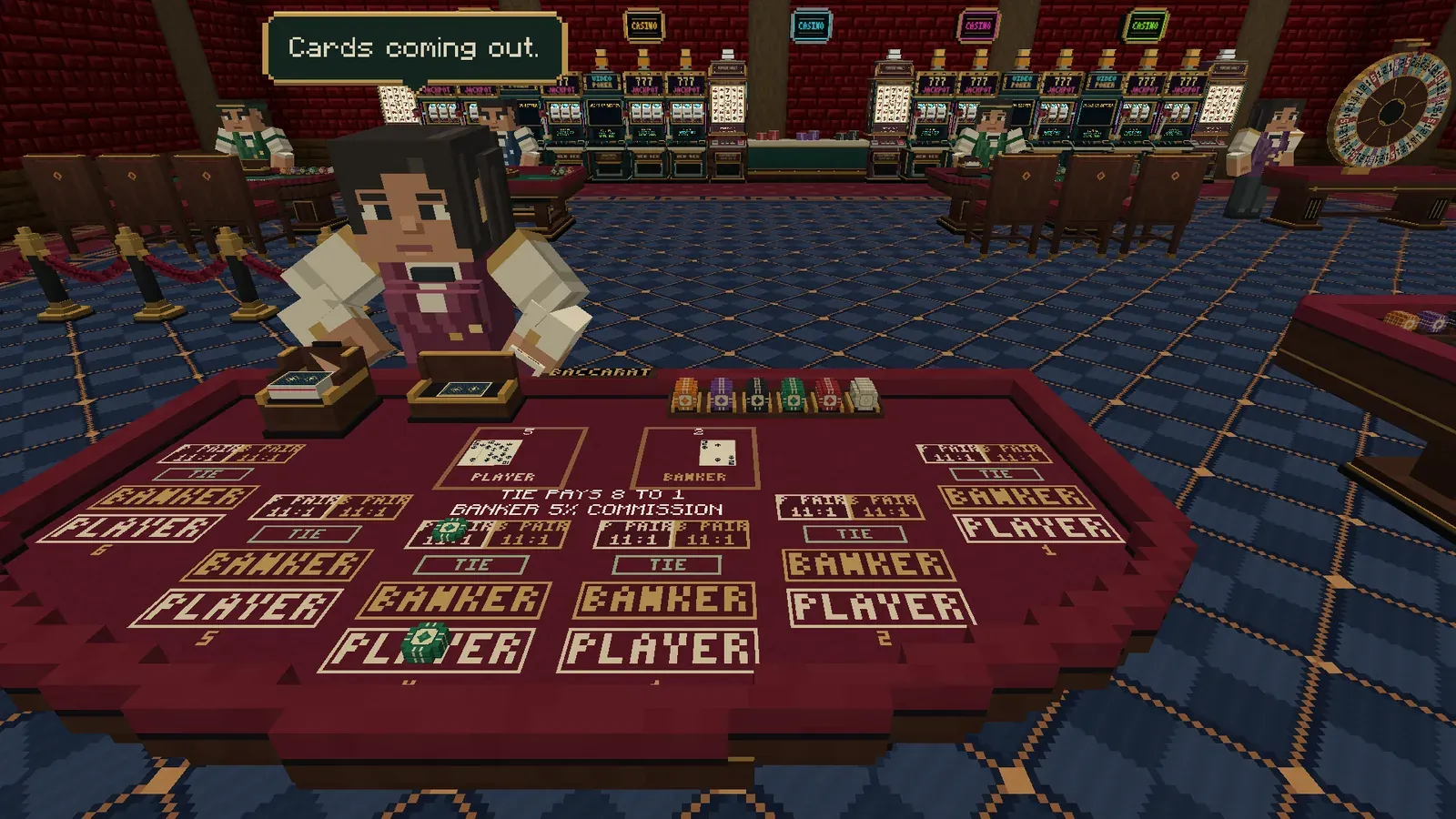
The Baccarat Table is the calm table. You bet on the Player’s hand, the Banker’s hand or a tie, and after that nobody decides anything. Both hands play by fixed rules, so all the fun is in the wait.
Getting one
Section titled “Getting one”Craft it from Burgundy Casino Felt, paper, planks and a Card Shoe, a part you make first. See Recipes. Place it with a 4 × 2 space clear on the ground and the two spaces above its back row free.


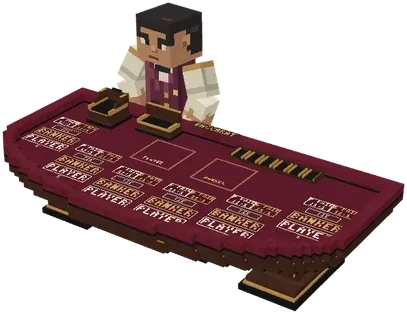
| The table | |
|---|---|
| Room | A 4 × 2 base, plus the two spaces above the back row where the shoe and the discard rack stand. Carpet in the way stays under the table. |
| Light | None |
| Hardness | 2.5. An axe is quickest, and anything breaks it. It drops one table, whichever part you break. |
| Owner | Whoever places it. One placed by a command has no owner, and anyone with a Pit Boss Key can run it. |
| Turning it | The  Croupier’s Wrench turns one you own a quarter turn with a Right-Click, but not mid-coup or with something in the way. |
| Seats | Seat 1 is on your right as you face the dealer. Seat 6 is on your left, and the two end seats sit nearer you. |
How to play
Section titled “How to play”Betting. Each of the six seats has its own five boxes on the felt. With  chips in hand, aimed at a box:
- Right-Click puts down the fewest chips that box accepts.
- Shift + Right-Click puts the whole stack on it.
- Right-Click with an empty hand takes back the chips on that box, while betting is open.
Your first chip claims the seat whose box you aimed at, and you bet from that seat only until your last chip leaves it.
| Box | What it backs |
|---|---|
| Player | The Player’s hand ending closer to nine. A tie gives the bet back. |
| Banker | The Banker’s hand ending closer to nine. It pays a commission when it wins, and a tie gives the bet back. |
| Tie | Both hands ending on the same total. |
| Player pair, Banker pair | That hand’s first two cards being the same rank, whoever wins. |
The deal. The first bet opens a betting window. When it closes, the cards come out on their own. Anyone with a bet down can Right-Click on the shoe to deal at once, and everyone betting is told who called it. Then both hands play themselves, the results go to chat, and winnings come to you as chips if you’re near the table. If you wandered off, they wait for your next Right-Click on the felt.
- Chips on a box
- Betting window
- The cards come out
- Both hands play themselves
- Winners paid
- The table clears
Where you aim decides what happens. The outline under your crosshair shows the box you’d bet on.
| You hold | Where | Right-Click | Shift + Right-Click |
|---|---|---|---|
| Chips |
A box | Puts down the fewest chips the box accepts | Puts the stack on it |
| Chips |
Anywhere else on the table | Collects anything the table owes you | Swaps small chips for bigger ones |
| An empty hand | Your own box, while betting | Takes back that box’s chips | The same |
| An empty hand | The shoe, with a bet down | Deals at once | The same |
| An empty hand | Anywhere else | Collects anything owed, or shows how long betting has left | The same |
 The Pit Boss Key |
Anywhere | Opens the owner’s settings |
- Each box covers the felt behind it up to the next box, so the gaps between boxes count too.
- “The shoe” is the whole dealer’s end of the felt: both hands’ squares, the shoe itself and the discard rack.
- The Banker box has its own minimum and step, set by the table’s rules card, so one small chip there can be refused. Every other box takes any whole amount.
- A box’s limit is on its total, so clicking twice can’t pass the table’s maximum.
- Look at the table with Shift held, wherever you aim, and its rules card appears at the side of your screen.
- The caption above your hotbar names the box you’re aiming at, what it pays and whose seat it is, then the running totals while the cards come out.
The parts
Section titled “The parts”Turn the table, zoom in, play what it does, and click a part to see what it’s for.
- Player box
- Backs the Player's hand. Each seat has its own five boxes; chips here claim this seat. Right-Click puts down the fewest chips the box takes, Shift + Right-Click the stack.
- Banker box
- Backs the Banker's hand. It pays a commission when it wins, and has its own minimum and step.
- Tie box
- Backs both hands ending on the same total.
- Pair boxes
- Player pair on the left, Banker pair on the right: that hand's first two cards being the same rank, whoever wins.
- The hands
- Player's cards on the left, Banker's on the right as you face the dealer. A third card lands laid across.
- Shoe
- Every card comes from here. With a bet down, Right-Click on it, or anywhere on the dealer's end of the felt, deals at once.
- Discard rack
- Played cards end up here, and it grows as the shoe shrinks.
- Dealer
- A villager the owner hires with the Pit Boss Key. Deals and says the result; without one, the felt spells out the winner.
The rules
Section titled “The rules”- Cards count ace 1, two to nine as marked, tens and court cards 0. A hand counts only its last digit, so a 7 and an 8 make 5.
- A natural is 8 or 9 on the first two cards. Either hand having one means nobody draws.
- The Player draws a third card on 0 to 5 and stands on 6 or 7.
- The Banker follows the tableau, a fixed table of when it draws a third card, depending on its own total and the Player’s third card.
- The higher total wins. Equal totals tie.
| Banker has | Banker draws when the Player’s third card is |
|---|---|
| 0, 1 or 2 | Anything |
| 3 | Anything but an 8 |
| 4 | 2 to 7 |
| 5 | 4 to 7 |
| 6 | 6 or 7 |
| 7 | Never |
If the Player stood on two cards, the Banker draws on 0 to 5 like the Player.
- A pair means the same rank: a ten and a king are not a pair. A pair turns that hand’s total gold, with PAIR beside it.
- The shoe is shuffled on the server, and shuffled again once three quarters of it has been dealt.
Stakes and winnings
Section titled “Stakes and winnings”- Your bet is the chips on the box. They leave your hand when you click, and everyone can see the stack.
- The coup is settled the moment it’s dealt. The table draws every card and pays its book at once, then lays the cards out one by one.
- Winnings go to bettors within 16 blocks, as the fewest chips that make the amount. A full inventory holds the rest until you make room or log in again. Anyone further away or offline is owed theirs by the table until they Right-Click it.
- The rules are locked for a coup at its first bet, so reloading a datapack can’t change a round in progress.
- A coup survives a restart. The cards pick up where they were.
If the table is broken or the house goes under maintenance, bets placed before the deal come back, and a coup already dealt pays what it won. If you’re online it comes back as chips, and if you’re offline it’s held for your next login.
A bet is checked in this order
Section titled “A bet is checked in this order”- Table open
- Cards not out
- A bet on this table
- Your seat, or a free one
- Within the limits
- The Banker box's step
- Banked house can cover it
- Bet down
Timing
Section titled “Timing”-
A card leaves the shoe every 0.6 seconds, in the order Player, Banker, Player, Banker.
-
In the last second before the table clears, every card goes into the discard rack.
-
The result always comes 4.8 seconds after the deal, even when only four cards were needed.
-
The betting window is a server setting.
For owners
Section titled “For owners”- The owner, their co-owners and operators run the table with the Pit Boss Key: the six stools, the bet limits within the server’s, open and close, redstone control, hoppers, the dealer, the toke box, the owners list and, in a banked house, the bank.
- The commission, what the tie and the pairs pay, the decks and the Banker box’s step come from the rules card, not the owner.
- In a banked house a bet is only taken if the bank can cover the worst coup for the whole table, every stake included. See The banked house.
- A hired dealer deals from behind the felt and says the result. Without one, the felt spells out the winner. See Dealers.
Redstone
Section titled “Redstone”A comparator against any block of the table reads how many players have a bet down:
 0358101215
- The Pit Boss Key’s redstone control can open the table always, only with a signal, only without one, or for one coup per new signal.
- Hoppers, if the owner turns them on, feed chips into the table’s bank, never into a bet.
Breaking it
Section titled “Breaking it”| What breaks it | What happens |
|---|---|
 Any player, by default |
The table drops. Bets placed before the deal come back, a dealt coup pays what it won, and in a banked house the bank goes to the owner, or drops as chips if nobody owns the table. |
 A player who isn’t an owner, with protection.sealedTables on |
Refused with “This belongs to somebody else.” |
 An explosion, with protection.sealedTables on |
The table survives if it has an owner. |
 Anything, in a found casino whose bank isn’t running |
Nothing. It can’t be broken or blown up until the casino is running again. |
For servers
Section titled “For servers”baccarat.bettingWindowTicks,baccarat.minBetandbaccarat.maxBetset the window and the limits on one box.- The rules card is a datapack file,
data/<namespace>/baccarat_rules/standard.json: decks, the commission, what a tie and a pair pay, and the Banker box’s minimum and step. Every table plays the card namedstandard, so a datapack that replaces it changes every table. Its own bet limits don’t steer a table; the config’s do. See Odds and datapacks. games.disabledwithbaccarat_tableturns every baccarat table off./highrollers odds baccaratshows the current rules in game, and says whether the card is the shipped one. See Configuration.