 Run the house
The Pit Boss Key
The owner's tool for stools, limits, the bank, the ledger, staff and the whole house.
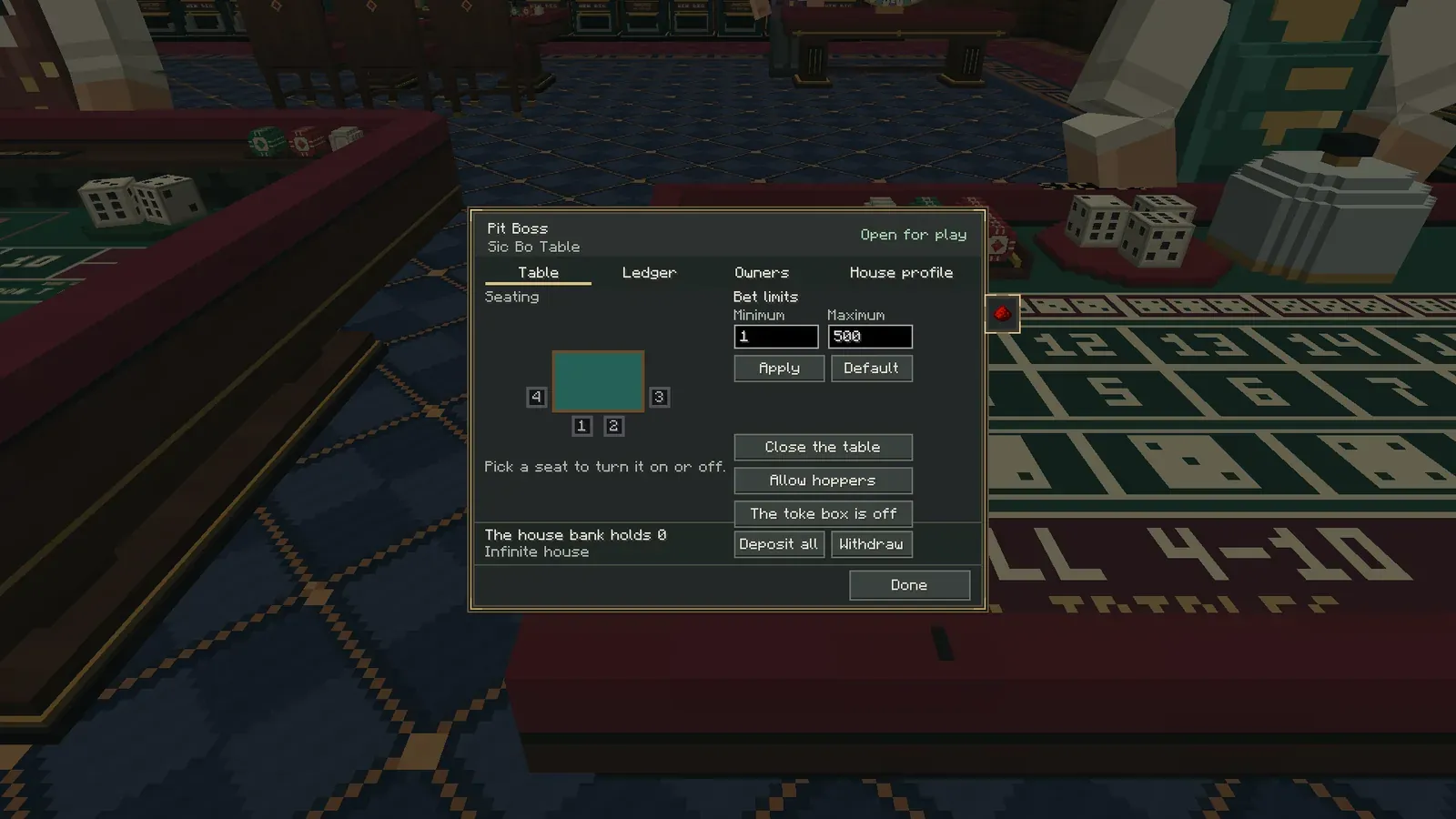
If you own a table, this is the item that lets you run it. Shift + Right-Click on the table with the Pit Boss Key in hand opens its settings.
Getting one
Section titled “Getting one”Craft it from a gold ingot, three gold nuggets and red wool, laid out like a key.
A key binds to one player: the one who crafts it, or the first one to use it. In anyone else’s hand it does nothing and says whose it is, so a lost or stolen key can’t run your casino. A copy is bound to the same player.


Who runs a table
Section titled “Who runs a table”- Whoever placed it owns it.
- Co-owners the owner names can run it too.
- Operators can run every table.
- A table nobody owns, because a dispenser or a command placed it, can be run by anyone with a Pit Boss Key.
- Hold your key
- Shift + Right-Click on the table
- The settings open
- Change what you need
- Done
- Hold the key in your main hand. The stock buttons read the stack in your off hand, because the key fills the main one.
- Operators are two permissions:
highrollers.house.manageruns any table as a co-owner would, andhighrollers.house.ownacts as any table’s owner. Both default to operators, and a permission manager can split them. - A table in a found casino opens the Casino screen first. See Breaking the bank.
- Hand over on a table nobody owns works for anyone, so the first player to use it can make the table theirs.
The settings
Section titled “The settings”Most tables have three tabs: Table, Ledger and Owners. The bingo cabinet and the game show add a Game tab. A cashier, a prize machine and the arcade machines have their own: stock, rates or prices, and owners.
The top of the screen says whether the table is open for play or closed, for whatever reason.
The Table tab
Section titled “The Table tab”- Seating. A top-down picture of the table with a seat at each stool position. Pick a seat to add or remove its stool.
- Bet limits. The smallest and biggest bet, anywhere inside the server’s range.
- Close the table and Open the table.
- Redstone control.
- The bank. What it holds, with Deposit all and Withdraw. See The banked house.
| Control | Where | What it does |
|---|---|---|
| Seating | Every table with stools | Pick a seat to add or remove its stool. |
| Bet limits | Tables with a server range | Set Min and Max, then Apply. You can narrow the range, never widen it. Default follows the server again. A table in a house sets its limits on the house screen instead. |
| Wheel | Roulette | Switches between the European and American wheels, while no bet is down. |
| Race | The racing cabinet | Switches between the Derby and the Tote between races, and sets the Tote’s least pool for the next race. |
| Jackpot link | Slot cabinets and video poker | Type a link’s name and Join. A new name makes a new link, and only its maker can add machines to it. Leave keeps the pool for the next machine. Names are letters, digits, _ and -. |
| Close the table | Every table | Stops new bets. A round already going finishes, and players can still cash out. It also sends the dealer home, and reopening doesn’t bring them back. |
| Hoppers | Tables a hopper can feed | Off by default. On, a hopper’s chips go into the bank, never to a player, and nothing ever comes back out. |
| Toke box | Blackjack, baccarat, roulette, Sic Bo, craps and the Big Six | Hangs a box for tips on the side. A tip goes into the bank in either house mode. |
| A free card a day | The scratch card machine | Gives every player one free card a day. In an infinite house everyone gets it anyway. |
| Redstone control | Every table, on the window’s edge | Always ignores redstone. With signal opens only while a signal reaches any block of the table, and Without signal only while none does. Once per pulse opens it for one round per new signal. A redstone close lets the round finish, then sends credits home. |
| The bank | Every table | Deposit all puts every chip you carry in. Withdraw takes out what the bank can spare. |
Hold’em’s limits are its buy-in, and Liar’s Dice’s stake is set by its rules file, so its boxes can’t move it.
The Game tab
Section titled “The Game tab”The bingo cabinet and the game show keep their game’s own choices here.
- Bingo: Cards (75-ball or 90-ball) and Game (ordinary or multiplier). In a banked house, also the card price, the three prizes and the overdraft floor.
- Game show: Show, High Rollers Vault or Casino Circuit.
- A choice is a button that steps to the next option. A number is a box and Set. An empty box follows the server, whose figure shows greyed in it.
- A row can wait. Bingo’s rows are fixed from the first card sold until the game ends, and the show’s until the round has paid. The row says so.
- Bingo’s price, prizes and floor only count in a banked house. In an infinite house they’re kept, and marked not in use.
- Only the owner moves the overdraft floor. It can’t go above the server’s cap, and zero means never borrow.
- Handing the cabinet on puts its price and prizes back to the server’s and clears its floor.
The Ledger tab
Section titled “The Ledger tab”The table’s take today, over the last seven days and all time, what was wagered and paid out, and the last settlements by name. A positive figure means the house is ahead. Every table keeps one, whichever house mode you run.
- The ledger keeps the last fifty settlements and sixty days.
- A cashier, a prize machine and the arcade machines have no Ledger tab.
The Owners tab
Section titled “The Owners tab”- Co-owners. Type a player’s name and Add co-owner. Co-owners can do everything except add or remove co-owners and hand the table over.
- Hand over gives the table to another player by name.
- Staff. Recruit or Release a dealer, and dress them in a Costume or a Jacket. See Dealers and staff.
- Up to eight co-owners. A name has to belong to somebody who’s been on the server.
- A handed-over table starts with no co-owners, and its own settings go back to the server’s. What the bank can spare pays off the old owner’s overdraft first.
- Hand over waits while a bingo game, a race or a game-show round is on, or a result is still showing.
- Recruiting takes the nearest unemployed adult villager within sixteen blocks, and needs the table open. In creative, or as an operator, a dealer appears at once.
- Closing a table sends its dealer home. If the villager can’t be given back, the table stays open.
Cashiers and machines
Section titled “Cashiers and machines”A cashier’s first tab is its stock, with a Take button for each item, its bank and a button that stocks the stack in your off hand. Its Rates tab sets what each item is worth. A prize machine has Prices, in comp points. See Chips and the cashier and Comps and rewards.
- Rates and prices take an item in the slot, a figure and Set. Server defaults clears the list.
- A cashier’s own rates only count in a banked house or a casino’s counter.
- Only plain items go into a prize shelf, and an item has to be priced first.
- Found equipment can’t go into stock.
The house screen
Section titled “The house screen”Tables on their own are just tables. A house is what a laptop connects to. The House profile button makes one.
- Create house makes a house here, and Join house adds another table you own to one. Each table keeps its own funds.
- Give it a name and a palette: the original, Green and gold, Teal and brass, Burgundy and silver, or Midnight and gold.
- The Owners tab names co-owners and transfers the house.
- The Online tab turns laptop play on or off, sets the laptop stake limits, and holds the house’s online bank. Rewards sets a welcome gift, free spins and missions.
See Getting online for what laptops see.
- Bet limits for a house are set once per game on the House tab and apply to every table of that game after the current rounds.
- Remove this table takes a table out of the house. Found equipment can’t be removed: break it and move it instead, and its funds stay the casino’s.
- Transfer house takes two clicks. It’s refused while the owner owes on their overdraft, or has a bingo game, a race or a game-show round borrowing on it.
- A handed-on house starts with no co-owners.
- Closing to laptops sends every open online stake back to its player.
- The online bank has its own Deposit all and Withdraw, and Withdraw pays off the owner’s overdraft first. On an infinite server, laptops don’t draw on it.
Other uses
Section titled “Other uses”- Leaderboard. Shift + Right-Click with your key opens its size settings, free of charge.
- Jukebox. Shift + Right-Click locks it, so only its owner can change what it plays, or unlocks it again.
- Bar. Right-Click on a Cashier and then on a bar counter with the key links them, so the barkeep trades from the cashier’s stock.
- A leaderboard comes in three sizes and grows up and to the right. You need building permission on every block it covers and clear space for it.
- A jukebox can be locked by its owner or an operator. One nobody owns is anyone’s.
- A bar link needs you to run both, the second click within a minute, and the bar within 128 blocks of the cashier.
The Croupier’s Wrench
Section titled “The Croupier’s Wrench”The key’s companion, an iron ingot and a stick. Right-Click on a table you run with it turns the table a quarter turn. It refuses during a round and when there isn’t room. A wrench belongs to nobody.
Shift + Right-Click carries a jackpot link from one cabinet to the next.


