 Getting started
Chips and the cashier
Where chips come from, what the cashier trades, and how to keep them safe.
Every game in High Rollers is played with chips. Nothing crafts a chip except taking a chip stack apart, so you get them from a Cashier, who turns things you carry into chips and buys them back. That one rule is why chips mean something.
The six chips
Section titled “The six chips”From the smallest to the biggest: white,  red,
 green,
 black,
 purple and
 orange.
Each colour is worth more than the last, and each one divides evenly into the next, so a big stake always breaks down into as few chips as possible. Hover over a chip to see what it’s worth. Chips stack to 64 like most items.
Chip stacks
Section titled “Chip stacks”A chip stack is a block you can set down on a table or a shelf. Four chips of one colour make one, and one gives four back, so nothing is gained or lost. It’s the only thing in the mod you can craft from chips.
- Place another of the same colour into it to add a stack, up to four in one block.
- Shift + Right-Click while placing sets a new one down beside it instead.
- Breaking it gives the block back, with as many stacks as it held. It never drops chips.
Getting chips
Section titled “Getting chips”- The Cashier. The main way in, covered below.
- The Pawnbroker. A villager who pays chips for rare finds. See The Pawnbroker.
- Winning. Tables and machines pay you in chips.
- Other mods. If your server runs an economy mod the cashier speaks to, it trades that money for chips too. See Integrations.
Getting a cashier
Section titled “Getting a cashier”


| The cashier | |
|---|---|
| Room | It needs the block above its spot clear. |
| Light | None |
| Hardness | 2.5. An axe is quickest, and anything breaks it. It drops itself. |
| Owner | Whoever places it. One placed by a dispenser or a command has no owner, and anyone with a Pit Boss Key can run it. |
| Turning it | The  Croupier’s Wrench turns one you own a quarter turn. |
- A laptop can stand on top of it.
Using the Cashier
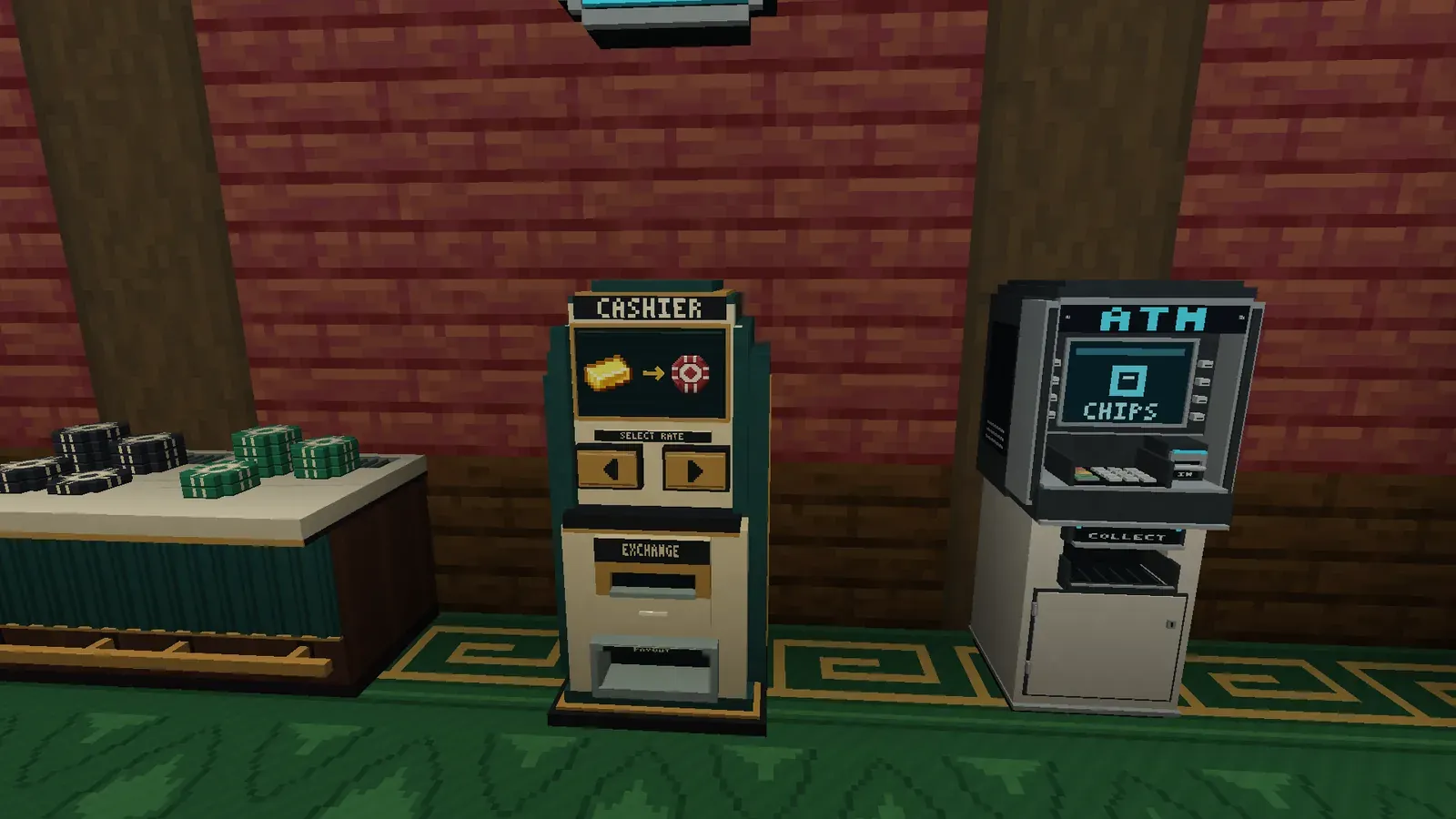
Section titled “Using the Cashier”The cashier has a screen at the top, two arrow buttons under it, the slot in the middle and a tray at the bottom. Everything happens at the slot.
- Buying chips. Right-Click on the slot with an item the cashier trades buys chips for one of the item. Shift + Right-Click trades the whole stack you’re holding.
- Choosing an item to buy back. The arrow buttons step the screen through what this cashier trades.
- Selling chips. Right-Click on the slot with chips in hand buys one of the item on the screen. Its price comes out of all the chips you carry, and you get change. Shift + Right-Click buys as many as your chips cover.
- Cashing in tickets. A winning scratch card is paid here, by a cashier of the right house. See Scratch cards and pull-tabs.
- Hold what you want to trade
- Right-Click on the slot
- Chips or the item come back
- The arrows pick the next item
The caption above your hotbar always says what a Right-Click will do and what it costs.
Where you aim decides what happens.
| You hold | Where | Right-Click | Shift + Right-Click |
|---|---|---|---|
| An item it trades | The slot | Buys chips for one | Buys chips for the whole stack |
| Chips |
The slot | Buys one of the item on the screen | Buys as many as all your chips cover |
| A scratch card | The slot | Cashes it | The same |
| Anything else | The slot | Nothing. The caption says the cashier doesn’t trade it. | The same |
| Nothing | The slot | Tells you to put an item or chips in | The same |
| Anything | An arrow | Steps the screen on or back, round and round | The same |
 The Pit Boss Key |
Anywhere | Opens the owner’s settings |
- Look at the cashier with Shift held and a card lists every item it trades, cheapest first, with what each is worth and whether those are the server’s rates or this cashier’s own.
- The screen shows the item on offer, an arrow and the biggest chip its price makes. After a buy it jumps to the item you just traded.
- The tray is for show. Chips go straight into your inventory.
- A trade happens whole or not at all. If the cashier can’t pay, or your chips moved before it could take them, it says so and nothing changes hands.
- A scratch card with its foil still on is refused, and so is one already paid, or one sold by another house. A card with no prize is taken for nothing.
- Other mods’ money, where a server has it, shows as extra rows after the items. With an empty hand, Right-Click buys one lot of chips with it and Shift + Right-Click buys as many as your balance covers, up to 64 lots. With chips in hand, it sells chips for that money. See Integrations.
Keeping chips safe
Section titled “Keeping chips safe”An ATM holds your chips for you, with no fee and no interest. Craft it from iron ingots, a glass pane, a Card Reader and a block of iron.
- Paying in. Right-Click on the front with chips in hand pays in one chip. Shift + Right-Click pays in the whole stack.
- Taking out. With an empty hand, Right-Click wakes the screen. The keys beside it pick Withdraw, where you type an amount on the number keys and press pay, or Take all.
- Pay in all puts every chip you carry on deposit, and Statement shows your last few deposits and withdrawals.
- Chips in hand
- Right-Click to pay in
- Empty hand wakes the screen
- Withdraw or Take all
Only you can take your deposit out, and only at an ATM. No table or machine can bet from it. The laptop’s online games and market can: they take a stake from your deposit and pay winnings into it. Your laptop’s Bank tab shows your chips wherever you are. See Getting online.
The ATM
Section titled “The ATM”| The ATM | |
|---|---|
| Room | It needs the block above its spot clear. |
| Light | 6 |
| Hardness | 3. A pickaxe is quickest. It drops itself. |
| Owner | None. It isn’t a table: there’s no bank, no settings, and nobody can seal it. Pistons can’t push it. |
- The keys. Twelve number keys on the shelf, three action keys (cancel, clear and pay, with
*as clear and#as pay), and four keys down each side of the screen, named on the screen. - A key is a key whatever you hold, chips included. Any other item off the keys is refused: a cash machine takes chips.
- Your screen is yours. Each player sees their own balance and statement, and nobody else’s. An idle screen goes dark after five minutes.
- Typing more than you have is refused, not trimmed. An amount is at most nine digits.
- A withdrawal is paid in the fewest chips. What won’t fit in your inventory stays on deposit, and if nothing fits, nothing moves.
- The statement shows the last four deposits and withdrawals, read from the server’s audit log. With the log off, it says no record is kept.
- The deposit is per world. It survives death, and it’s the same at every ATM in that world.
- Maintenance doesn’t close an ATM, and a server can’t turn it off in
games.disabled. /highrollers account <player>shows what an online player has on deposit. It only reads.
Credits at a machine
Section titled “Credits at a machine”A slot machine or video poker cabinet doesn’t play with the chips in your hand. Feed chips into its coin slot and they become credits on that machine, and its tray pays every credit back as chips. See Slot machines.
When your pockets are full
Section titled “When your pockets are full”Chips a cashier or a table can’t fit in your inventory aren’t dropped. They’re held for you, and come back the next time you log in with room for them. Until then you’re reminded at each login. The ATM is the one exception: what won’t fit stays on deposit.
For owners
Section titled “For owners”- The rates. The Pit Boss Key sets this cashier’s own list. It’s used only where trades are real: in a banked house, a casino’s counter, or a cashier with its own goods. In an infinite house the server’s list always applies, and the key’s list is kept for later.
- In a banked house the cashier trades out of its own float and stock. Buying chips pays them from the float and puts the item in the stock. Selling them takes the chips into the float and the item out of the stock. Whatever isn’t there is refused.
- Stocking it. Hold the items in your off hand and press the stock button on the key’s screen. The owner can also take one item’s whole stock back out.
- Hoppers, when the owner allows them, feed chips into the float and traded items into the stock. Nothing ever comes back out.
- A comparator always reads nothing.
- In an infinite house chips simply appear and vanish, and the stock still counts what’s been paid in.
Breaking it
Section titled “Breaking it”| What breaks it | What happens |
|---|---|
 Any player, by default |
The cashier drops itself, and its stock drops as items. The float goes to the owner, or drops as chips if nobody owns it. |
 A player who isn’t an owner, with protection.sealedTables on |
Refused with “This belongs to somebody else.” |
 An explosion, with protection.sealedTables on |
The cashier survives if it has an owner. |
 Anything, at a found casino’s counter nobody has claimed |
It drops nothing. Its goods go with it. |
For servers
Section titled “For servers”cashier.ratesis the default list, onenamespace:item=creditsline per item. An item the game doesn’t know is skipped and logged, and a repeated item keeps its last line.- With Lightman’s Currency installed and the list left as shipped, the emerald’s rate changes to fit Lightman’s coins. A list the server writes is kept as written.
house.modepicks an infinite or a banked house. See The banked house.cashieringames.disabledcloses every cashier.audit.enabledkeeps the log the cashier’s trades and the ATM’s statement are read from.- The
economysections set the rate for each other mod’s money. See Integrations.